Teagan Donnelly

Computer Science Student | University of South Carolina

Turning ideas
into impact.

Computer Science student at the University of South Carolina building thoughtful software through full-stack development, collaborative engineering, and product design.

Open to Summer 2027 Software Engineering Internships
View Résumé

SELECTED PROJECTS

Recent work

Hackathon prototypes and collaborative engineering projects.

VIEW ALL PROJECTS
HEALTHCARE

Camellia

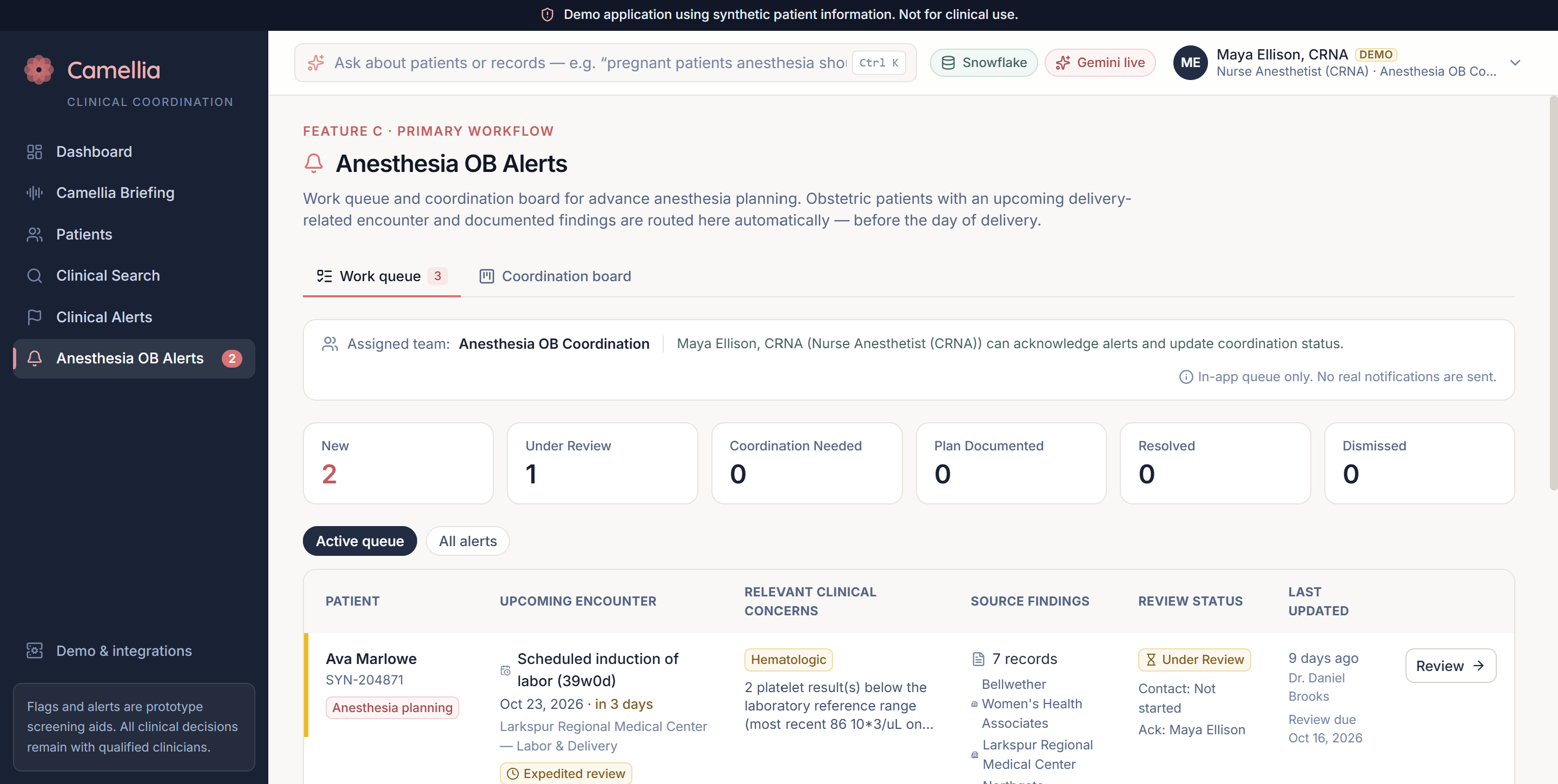
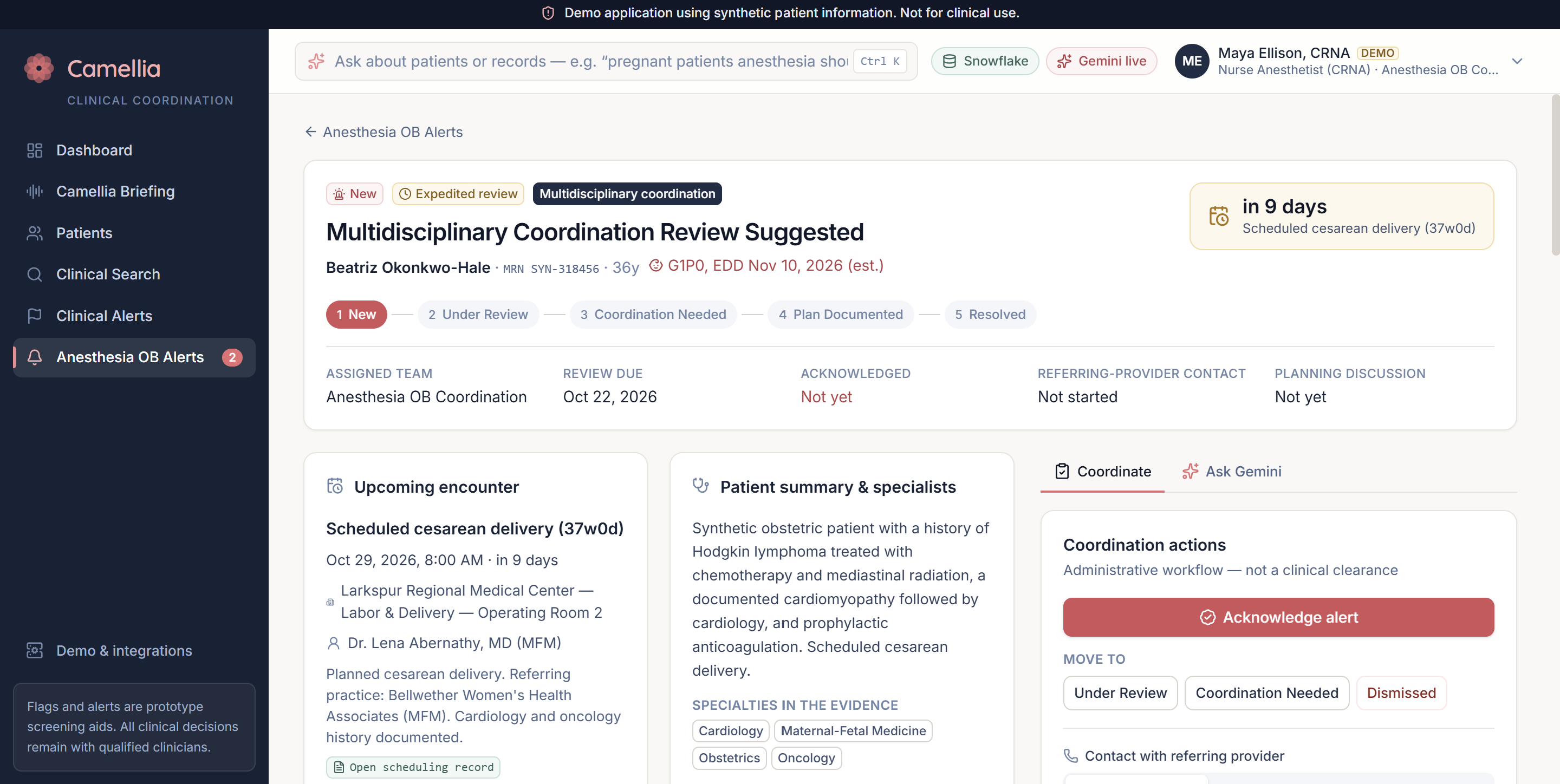
A clinical intelligence platform that unifies fragmented medical records, identifies patterns requiring clinical review, and supports OB anesthesia coordination.

Completed hackathon prototype · Exploring what comes next

  • Java
  • React
  • Snowflake
  • Gemini
  • ElevenLabs
View Project
NONPROFIT

HOPE Foundation

Collaborating with a five-developer team to build an accessible, full-stack website for a nonprofit supporting affordable prosthetic solutions.

Ongoing client work

  • TypeScript
  • Node.js
  • Git/GitHub
  • Vercel
View Project
DISASTER RELIEF

Hurricane Relief Coordination System

Built with a five-person team, this Java backend organizes assistance requests and relief coordination. My work focused on request management and aid coordination.

Backend complete · Testing in progress

  • Java
  • Maven
  • OOP
  • UML
  • JSON
  • Git/GitHub
View Project
FINANCIAL TECHNOLOGY

Vesta

An AI-powered financial planning prototype helping individuals and groups anticipate financial risks, explore hypothetical decisions, and coordinate shared financial responsibilities with customizable privacy controls.

Completed Technica 2026 Hackathon Prototype

  • Next.js
  • TypeScript
  • Gemini
  • Backboard
View Project
  • Computer Science · USC ’28
  • Software & Product Development
  • Hackathon & Client Projects

SELECTED WORK

Things I’ve built

A collection of projects exploring software engineering, product development,
and technology that solves real-world problems.

“Ideas are more meaningful when they create real change.”
4 PROJECTS

02 / COURSEWORK PROJECTS

8 PROJECTS
01 / 08

Stock Market Observer

Notifies trading applications of price changes in subscribed market sectors.

  • Java
  • Observer Pattern
  • HashMaps
View Code
02 / 08

Vocabulary State Game

Changes vocabulary game behavior and difficulty across first-, second-, and third-grade states.

  • Java
  • State Pattern
  • OOP
View Code
03 / 08

Hockey Strategy Simulator

Simulates hockey players dynamically selecting interchangeable playing behaviors.

  • Java
  • Strategy Pattern
  • Inheritance
View Code
04 / 08

Warrior Gear Decorator

Layers decorators onto an ASCII warrior to add swords, shields, and armor.

  • Java
  • Decorator Pattern
  • OOP
View Code
05 / 08

Robot Command Simulator

Processes queued commands to move a robot around a board with obstacles.

  • Java
  • Queues
  • Object-Oriented Programming
View Code
06 / 08

Video Game Database Search

Loads and searches a video game database by title, console, or wildcard.

  • Java
  • File I/O
  • Search Algorithms
View Code
07 / 08

Shape Manager BST

Manages shapes in a binary search tree organized by area.

  • Java
  • Binary Search Trees
  • File Processing
View Code
08 / 08

Sheep Shearing Scheduler

Schedules sheep by shortest shearing time, then alphabetical order.

  • Java
  • Priority Queues
  • Scheduling Algorithms
View Code
BUILT ON A FOUNDATION OF CURIOSITYLEARNING TODAY, BUILDING TOMORROW

ACADEMIC FOUNDATION

Behind the build

These courses have shaped my technical foundation and the way I approach software, systems, and real-world problem solving.

“A strong foundation today builds a more meaningful tomorrow.”

8 COURSES

CSCE 247

Software Design

Software Engineering

Fundamentals of software design and development, including requirements, design patterns, testing, and project management.

  • Requirements
  • UML
  • Design Patterns
  • Testing
  • SDLC
CSCE 145

Programming

Algorithmic Design I

Problem-solving, algorithmic design, and programming through structured problem analysis and implementation.

  • Java
  • Problem Solving
  • Algorithms
  • Programming Fundamentals
CSCE 146

Programming

Algorithmic Design II

Development of algorithms and computer programs with an emphasis on object-oriented programming and data structures.

  • Java
  • Data Structures
  • Recursion
  • OOP
CSCE 101

Computing & Society

Computing in the Modern World

An introduction to computing, including its impact on society, current technologies, professional opportunities, and research.

  • Technology & Society
  • Professional Development
  • Current Trends
CSCE 211

Systems & Hardware

Digital Logic Design

Number systems, Boolean algebra, logic design, and the analysis of combinational and sequential logic circuits.

  • Boolean Algebra
  • Logic Gates
  • Combinational Circuits
  • Sequential Circuits
CSCE 212

Systems & Hardware

Introduction to Computer Architecture

Computer organization, memory addressing, input/output, instruction sets, and assembly-language programming.

  • RISC-V Assembly
  • Memory
  • CPU Organization
  • Instruction Sets
CSCE 240

Systems & Hardware

UNIX/Linux Fundamentals

UNIX operating systems, user-level commands, shell programming, file systems, and development tools.

  • Linux Commands
  • Shell Scripting
  • File Systems
  • Development Tools
MATH 374

Math & Theory

Discrete Structures

Propositional and predicate logic, proof techniques, sets, relations, combinatorics, and graph theory.

  • Logic
  • Proofs
  • Sets
  • Relations
  • Combinatorics
  • Graphs
BUILT ON A FOUNDATION OF CURIOSITYLEARNING TODAY, BUILDING TOMORROW
Teagan Donnelly

A LITTLE ABOUT ME

Hi, I’m Teagan.

I’m a Computer Science student at the University of South Carolina interested in full-stack development and product design. From healthcare tools to financial applications, I enjoy taking an idea through requirements, interface design, and implementation. I like collaborative engineering and building features that make complex information easier to use.

  • Software Engineering
  • Product Development
  • Full-Stack
  • Class of 2028
A sunlit workspace beside a window

WHAT I BUILD

Technology
with purpose.

I build healthcare tools, financial planning features, and consumer applications, with a focus on clear interfaces and useful functionality.

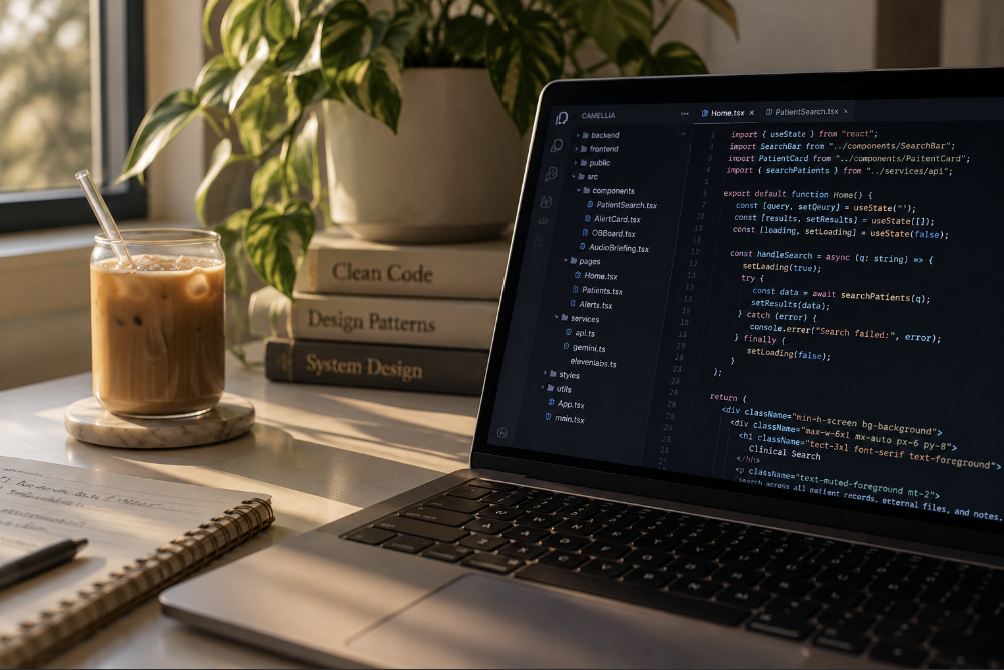
A coding workspace with a laptop

HOW I WORK

From idea to implementation.

I enjoy understanding problems, translating them into features, and collaborating across design, engineering, and stakeholders to build products people actually use.

Notebook with interface sketches beside a laptop

BEYOND THE CLASSROOM

Building
beyond coursework.

Through hackathons, client work, and personal projects, I’ve had opportunities to explore new technologies, solve meaningful problems, and strengthen both my technical and collaborative skills.

Sunlight on the University of South Carolina campus

PROFESSIONAL EXPERIENCE

Work Experience

HOPE Foundation

Full Stack Software Engineer

Columbia, SC
September 2026 – Present

  • Collaborate on a five-developer team building a full-stack website for HOPE Inc., a nonprofit supporting affordable prosthetic solutions.
  • Translate stakeholder requirements into technical and UX decisions for a maintainable production website.
  • Contribute to responsive design, accessibility, content management, and deployment planning.
  • Help design configurable donation functionality and participate from requirements gathering through implementation, testing, deployment, and handoff.

TypeScript, Node.js, Git/GitHub, Vercel

Stylish Patina Boutique

Retail Associate & Content Creator

Falls Church, VA
September 2024 – Present

  • Independently open, operate, and close the boutique, managing daily operations and customer needs.
  • Train new employees on store procedures, Shopify, customer service, and inventory operations.
  • Create social media content and product photography supporting the boutique’s digital presence.
  • Maintain e-commerce listings, product descriptions, and online inventory.

EDUCATION

Education

University of South Carolina

B.S. Computer Science

Columbia, SC
Expected May 2028

Relevant Coursework: Software Engineering, Algorithmic Design, UNIX/Linux, Discrete Structures, Computer Architecture, Design Patterns, Ethics in Computing

SKILLS

Technical Skills

  • Java
  • Python
  • JavaScript
  • TypeScript
  • HTML/CSS
  • React
  • Node.js
  • Spring Boot
  • Git/GitHub
  • Vercel
  • UML
  • Linux
  • Shopify
  • RISC-V Assembly

Project-specific integrations

  • Snowflake
  • Gemini
  • ElevenLabs
  • Nessie
  • Backboard
OPEN TO OPPORTUNITIES & COLLABORATIONSBASED IN COLUMBIA, SC

GET IN TOUCH

Let’s connect.

Have a project in mind, an opportunity to share, or just want to say hello?
I’d love to hear from you.

OPEN TO OPPORTUNITIES & COLLABORATIONSBASED IN COLUMBIA, SC

SOFTWARE ENGINEERING / DISASTER RESPONSE

Hurricane Relief
Coordination System

Connecting communities in need with the people ready to help.

Developed by a five-person team at the University of South Carolina, the Hurricane Relief Coordination System is a Java-based application designed to organize assistance requests, volunteer coordination, and critical information during hurricane recovery.

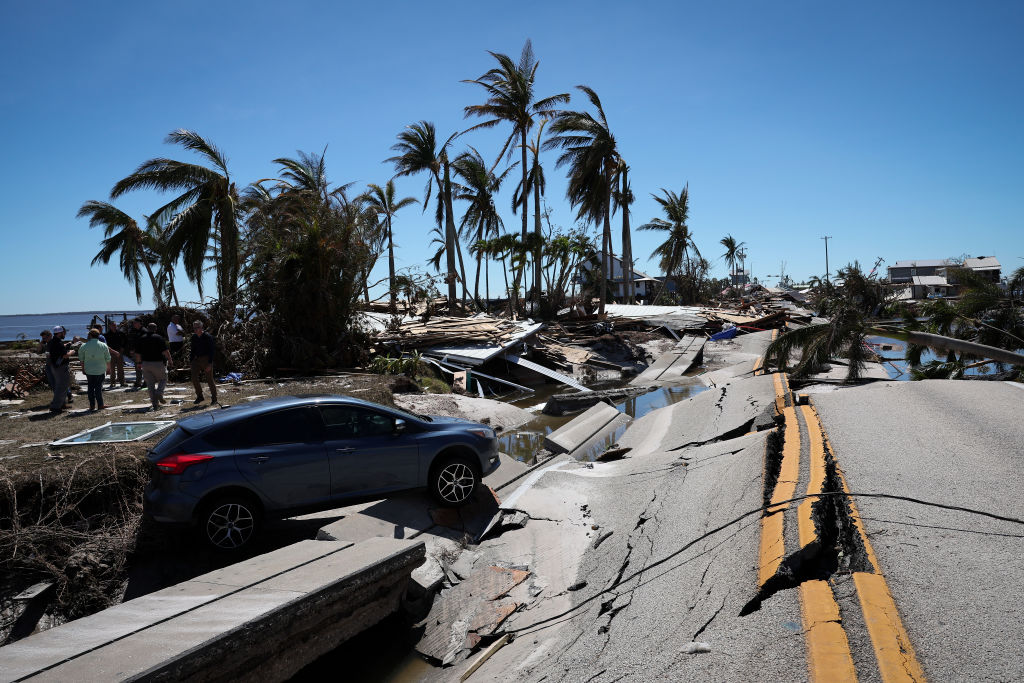
Storm clouds over the ocean and shoreline

Collaborative academic software engineering project · Not a deployed emergency-response service.

01 / THE PROBLEM

When disasters strike,
information becomes fragmented.

During hurricane recovery, people in need, volunteers offering help, and coordinators often struggle to communicate quickly and effectively. Critical information about urgent needs, available resources, and ongoing operations can become scattered across multiple channels.

Floodwater covering a residential street

Fragmented Communication

People in need, volunteers, and coordinators often use separate channels.

Time-Sensitive Needs

Urgent requests require fast, organized coordination.

Critical Information

Recovery efforts depend on accurate, up-to-date information.

02 / SYSTEM DESIGN

Three roles.
One coordinated response.

The system connects aid requesters, volunteers, and aid coordinators through a Java backend with specialized managers for requests, accounts, volunteers, and shelters.

Aid Requesters

Submit and manage requests for assistance.

Volunteers

Provide availability, skills, credentials, and resources.

Hurricane Relief
Application

(Java Backend)

  • RequestManager
  • VolunteerManager
  • AccountManager
  • ShelterManager
  • DataLoader / DataWriter
JSON data persistence

Aid Coordinators

Review requests, assign urgency, review volunteers, and coordinate assignments.

Shelters & Events

Shelter information, hurricane events, and location data.

Conceptual domain relationships, not a GUI or an exhaustive class-dependency diagram.

03 / REQUEST LIFECYCLE

From requesting help
to a completed response.

Requests carry identifiers, assistance types, urgency, locations, and status. The model distinguishes personal assistance requests from infrastructure reports.

  1. Submitted

    Request created with details and location.

  2. Reviewed

    Coordinator reviews the request and assigns urgency.

  3. Assigned

    An eligible volunteer is assigned.

  4. In Progress

    Assistance moves through response stages.

  5. Completed

    Completion is recorded under shelter-manager permissions.

Simplified representative workflow, not an exhaustive state-transition diagram. The enum also includes pending review, approved, awaiting assignment, en route, arrived, denied, and canceled. Cancellation is distinct from completion.

04 / TECHNICAL IMPLEMENTATION

Built with Java
and object-oriented design.

Domain models, enums, and manager classes separate responsibilities. JSON-backed records support storage through DataLoader and DataWriter.

  • Java
  • Maven
  • OOP
  • UML
  • JSON
  • Git & GitHub
public void updateRequest(String comment, AssistanceType assistanceType,                        Location location, String photo) {     if (requestStatus == RequestStatus.CANCELED ||        requestStatus == RequestStatus.COMPLETED) {        throw new IllegalStateException(            "Cannot edit a canceled or completed request."        );    }     this.comment = comment;    this.assistanceType = assistanceType;    this.location = location;    this.photo = photo;    }

Exact excerpt · HelpRequest.java · request editing

05 / MY CONTRIBUTIONS

Key classes I implemented.

My primary work focused on request functionality and aid coordination within a five-person team, alongside UML design, shared class interfaces, Git branching, merging, and integration.

HelpRequest.java

Managing assistance requests

  • Designed request constructors and stored request details.
  • Implemented request editing and cancellation guards.
  • Handled urgency classification and status access.
  • Connected UUIDs, users, locations, and typed states.

AidCoordinator.java

Supporting relief coordination

  • Setting and updating manual request urgency.
  • Accepting manual certification and background-review decisions.
  • Supporting assignment checks and volunteer coordination.

Current class: Coordinator.java. Review methods do not call real background-check services. Automatic assignment behavior is not independently verified here.

06 / DEVELOPMENT PROCESS & STATUS

From requirements to testing.

A semester-long team effort: requirements and UML design led to Java backend implementation. The team reports backend implementation complete, with integration testing and issue resolution underway.

  1. Requirements

    Stakeholder analysis and SRS documentation.

  2. UML Design

    Class and sequence diagrams.

  3. Backend Development

    Java implementation and integration.

  4. Testing

    In progress: verification and issue resolution.

Read the Software Requirements Specification

Testing is underway; no passing test counts or coverage are asserted. Production deployment is outside the completed scope.

Engineering for moments that matter.

This project has strengthened my experience translating real-world problems into structured software requirements, object-oriented designs, and collaborative Java implementations.

Back to Projects

CLIENT PROJECT / IN PROGRESS

HOPE Inc.

Building a digital home for a mission that matters.

I’m collaborating with a five-developer team through Kappa Theta Pi to build a full-stack website for HOPE Inc. (Hands On Prosthetic Engineering), a nonprofit working to make prosthetic solutions more accessible and affordable.

Our work focuses on translating the organization’s needs into an accessible, maintainable website that supports its mission and future growth.

An open prosthetic hand

01 / THE MISSION

Technology in service of accessibility.

HOPE Inc. works to improve access to affordable prosthetic solutions. Our team’s responsibility is to create a digital experience that communicates the organization’s mission clearly, helps visitors understand its work, and provides a foundation the organization can maintain and expand.

ACCESSIBILITY

Designing for usability across devices and audiences.

CLARITY

Making the organization’s mission and information easy to understand.

SUSTAINABILITY

Building a website the organization can maintain and grow.

02 / MY CONTRIBUTION

From approved design to working code.

ABOUT PAGE DESIGN & DEVELOPMENT

A design approved.
An experience taking shape.

I created the About page design in Figma and refined it through review and approval. I’m now implementing the approved design as responsive, maintainable frontend components.

Throughout implementation, I collaborate with the team to keep the page consistent with the larger website.

  1. 01
    Design in Figma
    Complete
  2. 02
    Client/Team Approval
    Complete
  3. 03
    Frontend Implementation
    In progress

03 / THE PROCESS

Building with the client in mind.

Our project workflow — a guide to the work, rather than a list of completed milestones.

  1. 01

    DISCOVER

    Understand the nonprofit’s goals and website requirements.

  2. 02

    DESIGN

    Translate those needs into clear, accessible page designs.

  3. 03

    DEVELOP

    Implement responsive pages using our team’s development stack.

    Current focus
  4. 04

    REFINE

    Review, test, and prepare the website for future deployment and handoff.

    Ahead

04 / THE STACK

Built collaboratively.

  • TypeScript
  • Node.js
  • Git
  • GitHub
  • Vercel

Working as part of a five-developer team has given me experience translating stakeholder needs into technical decisions while coordinating design and implementation across a shared codebase.

05 / CURRENT STATUS

A work in progress,
with a real purpose.

ACTIVE DEVELOPMENT

Development is underway. My current focus is implementing the approved About page design and contributing to a consistent, accessible website experience.

As the project progresses and client-approved materials become available, I’ll update this case study with more details about the finished work.

Have a project in mind?

Let’s connect
Back to Projects

Camellia

Clinical intelligence for
more proactive patient care.

Camellia is an AI-powered healthcare prototype designed to connect fragmented patient records, surface potentially overlooked clinical concerns, and support proactive care coordination. Developed during PalmettoHacks 2026, the platform combines unified clinical search, evidence-linked AI analysis, obstetric anesthesia coordination, personalized audio briefings, and simulated wearable monitoring.

Best Use of HardwarePalmettoHacks 2026
Best Use of ElevenLabsPalmettoHacks 2026
Hospital care scene illustrating Camellia's patient monitoring concept

01 / THE PROBLEM

Critical information
gets missed.

Patients with complex medical histories often receive care across multiple providers and record systems. When important information is fragmented, clinical teams may not have the full picture before a scheduled procedure or delivery. Camellia explores how unified information and earlier coordination could support more informed care.

Fragmented records

Important patient information is scattered across systems and can be difficult to find quickly.

Missed risk factors

Relevant clinical history may not be recognized early enough for advance planning.

Delayed coordination

Care teams may lack the shared context needed to prepare for complex cases.

02 / THE PLATFORM

A clearer picture of patient care.

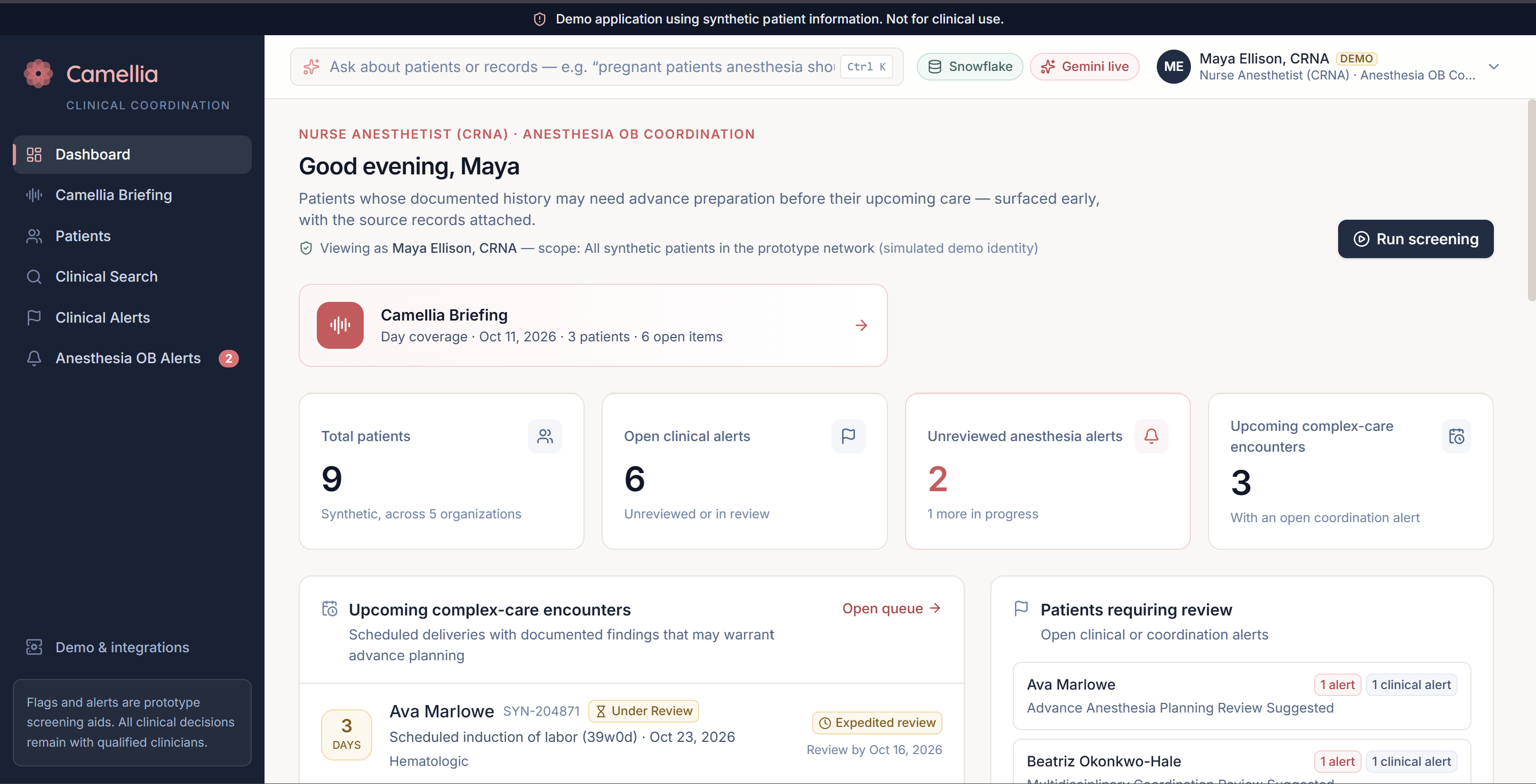
Camellia is a clinical intelligence prototype that brings together searchable patient records, evidence-linked clinical flags, proactive anesthesia coordination, and personalized audio briefings in one interface.

  • Unified Clinical Search

    Search across fragmented patient records.

  • Evidence-Linked Clinical Flags

    Surface potentially overlooked findings with supporting source references.

  • OB Anesthesia Coordination

    Help care teams identify complex upcoming deliveries and prepare earlier.

  • AI Audio Briefings

    Generate concise, personalized patient and shift summaries.

Camellia prototype dashboard with synthetic patient summaries and clinical coordination tools

Prototype demonstration uses synthetic patient information. Not intended for clinical use.

03 / INSIDE THE APPLICATION

Built around clinical workflows.

04 / THE HARDWARE CONCEPT

Extending care beyond the screen.

The Camellia Smart Monitoring Band is a proposed reusable wearable designed to support continuous in-hospital monitoring. The concept combines movement tracking, pulse oximetry, and skin temperature sensing with a replaceable strap and reusable sensor pod.

Conceptual device. A physical prototype has not been completed or clinically validated.

  • Movement Monitoring

    Proposed accelerometer-based activity and fall monitoring.

  • Vital Sign Sensing

    Conceptual pulse oximetry and skin temperature tracking.

  • Reusable Design

    Reusable sensor pod with a replaceable hospital strap.

AI-generated studio concept rendering of the proposed Camellia monitoring band
AI-generated concept rendering. Physical prototype in development.

Explore the hardware architecture

A conceptual look at how wearable sensor data could move through local processing, hospital systems, and the Camellia application.

View Architecture Diagram
AI-generated conceptual illustration of the proposed reusable wearable, sensor components, and replaceable strap

AI-generated conceptual illustration. Architecture and cost estimates are preliminary; the physical sensor system has not yet been validated.

Open full proposed data pathway and preliminary cost diagram

05 / TECHNOLOGIES

Built with modern tools.

  • Java
  • Spring Boot
  • React
  • Snowflake
  • Gemini
  • ElevenLabs

06 / WHAT’S NEXT

From prototype to possibility.

Following PalmettoHacks, our team is continuing to explore Camellia’s potential, including development of a physical sensor prototype and participation in Boyd Startup Night.

Camellia image

Vesta

Financial accountability
without financial surveillance.

Vesta is an AI-powered financial planning platform that helps individuals and groups anticipate financial risks, explore solutions, and coordinate shared financial responsibilities without sacrificing privacy.

Supplied Vesta hero visual showing its financial dashboard in a botanical setting

01 / THE PROBLEM

Shared financial responsibilities aren’t simple.

Financial decisions rarely affect just one person. Roommates, partners, and families often share expenses and financial goals, but traditional budgeting tools focus primarily on individual finances. Vesta helps people coordinate commitments without exposing their entire financial lives.

A warm sunlit planning workspace with a notebook and laptop

Different Relationships, Different Expectations

Roommates, partners, and family members may need different levels of financial visibility.

Privacy Matters

Users can communicate financial readiness without automatically revealing sensitive personal information.

Risks Are Often Unseen

Upcoming shortfalls can be difficult to anticipate before they affect shared commitments.

02 / KEY FEATURES

Plan, protect,
and grow together.

Vesta combines predictive financial forecasting, shared workspaces, and AI-powered guidance to help users make informed decisions and coordinate shared financial responsibilities.

  • Shared Financial Workspaces
  • Predictive Financial Modeling
  • AI-Powered Financial Guidance
  • Relationship-Specific Privacy Controls
  • Interactive What-If Simulations
Search financial tools…Demo data   ·   Kevin

Group Health

Different commitments. Relationship-specific sharing.

Maple Street Roommates
On Track

Kevin · Maya · Noah · Lily

Kevin’s rent share
$600 covered
Kevin’s utilities share
$100 covered

Readiness is shared; individual finances stay private unless each member authorizes more.

Kevin & Ava — Vacation
At Risk

Vacation target · October 27

Kevin’s agreed share
$400
Projected readiness
$200

Vacation readiness is calculated after rent, utilities, and other scheduled spending.

Case-study visualization of the documented fictional scenario, not an application screenshot. Simulated identities and browser-local persistence.

03 / PREDICTIVE MODELING

See the impact
before it happens.

Vesta’s Domino simulator models hypothetical financial decisions so users can explore how potential changes affect their future balances and shared commitments.

Try the Domino Simulator
Before — Original Outlook
−$200Projected minimum cash balance
Vacation contribution
$200 shortfall
$2000$1000$0Oct 17Oct 21Oct 24Oct 27Oct 30−$200

$400 required; $200 ready. Deducting the full vacation commitment produces a −$200 minimum cash balance.

After — Delaying a $330 Purchase
$130Projected minimum cash balance
$400 vacation share
Covered
$2000$1000$0Oct 17Oct 21Oct 24Oct 27Oct 30$130

$400 contribution covered. The separate $130 figure is minimum cash after obligations; rent and utilities remain covered.

Actual deterministic output from Vesta’s fixed fictional Kevin snapshot, October 17–30, 2026. The adjusted plan delays the optional $330 purchase from October 24 to October 30. Expected payroll on October 28 drives the rise. These are hypothetical projections, not executed transactions.

04 / AI-POWERED GUIDANCE

Financial guidance
that understands context.

Ask Vesta integrates Google Gemini to provide personalized financial explanations and recommendations using relevant financial context. Optional conversational memory supports more consistent guidance while keeping users in control.

Application logic calculates the forecasts. Gemini explains the calculated facts and suggests options.

V Ask VestaIllustrative conversation

Can I still afford my vacation contribution if I keep my gym membership?

Your current projection indicates a $200 shortfall toward your vacation commitment. Delaying your optional equipment purchase may allow you to meet the contribution without affecting your rent or utilities.

Illustration based on the fictional demo — not a captured Gemini response.

05 / TECHNICAL IMPLEMENTATION

Built with modern tools
and a privacy-first design.

A full-stack financial planning prototype built with Next.js, React, and TypeScript, combining deterministic forecasting, Gemini-powered guidance, and permission-aware shared views.

  • Next.js
  • React
  • TypeScript
  • Tailwind CSS
  • Gemini API
  • Backboard

Browser-local fictional data. Nessie is a sandbox banking integration, not the source of the demo transactions. Tiger Data was explored and removed from the final demonstration.

financial-view.tsScenario comparison
export function affectedBalances(  baseline: CashFlowProjection,  scenario: CashFlowProjection,) {  const byDate = new Map(scenario.points.map((p) => [p.date, p]));  return baseline.points.flatMap((p) => {    const s = byDate.get(p.date);    return s && s.balanceCents !== p.balanceCents      ? [          {            date: p.date,            baseline: p.balanceCents,            scenario: s.balanceCents,            difference: s.balanceCents - p.balanceCents,          },        ]      : [];  });}

Exact source excerpt · lib/financial-view.ts

06 / DEVELOPMENT PROCESS

From idea to prototype
in a weekend.

Developed during Technica 2026, Vesta evolved from personal financial planning into a collaborative prototype focused on shared responsibilities, forecasting, and privacy.

October 17–18, 2026 · Testing focused on key scenarios; no current test-count claim is made here.

  1. Ideation & Requirements

    Identify the problem, user scenarios, and core features.

  2. System Design

    Plan models, permissions, and financial workflows.

  3. Development

    Implement forecasting, workspaces, and AI integrations.

  4. Polishing & Demo

    Refine the interface and prepare the demonstration.

Building technology for more thoughtful financial decisions.

Vesta demonstrates how predictive modeling, AI assistance, and intentional privacy design can help people navigate financial responsibilities together.

Completed hackathon prototype. Simulated identities, fictional data, and browser-local persistence; not production authentication, bank-account management, or real-time multiuser synchronization.